
Why Lambda Scaling Can Overwhelm Your Database
AWS Lambda removes much of the work involved in scaling application compute, but your database does not automatically gain the same elasticity. A sudden increase in Lambda concurrency can create enough database connections and parallel queries to turn successful compute scaling into database saturation.
The important design question is not simply “How far can Lambda scale?” It is “How much concurrent work can the database safely absorb?”
Lambda and relational databases scale differently
Lambda concurrency is the number of function invocations executing at the same time. As traffic increases, Lambda can create additional execution environments to process requests in parallel. AWS explicitly recommends understanding downstream throughput constraints because those dependencies may not scale at the same rate as Lambda.
A relational database such as Amazon RDS or Aurora has different constraints:
- available CPU and memory;
- maximum and practical connection capacity;
- query execution time;
- locking and transaction contention;
- disk and network throughput.
Imagine an API where each Lambda invocation opens a database connection.
Client
  |
API Gateway
  |
Lambda x 10
  |
Amazon RDS
At low traffic this may work perfectly.
Now traffic increases:
Client Requests
      |
  API Gateway
      |
Lambda Lambda Lambda Lambda Lambda ...
   \     |      |      |      /
        Database
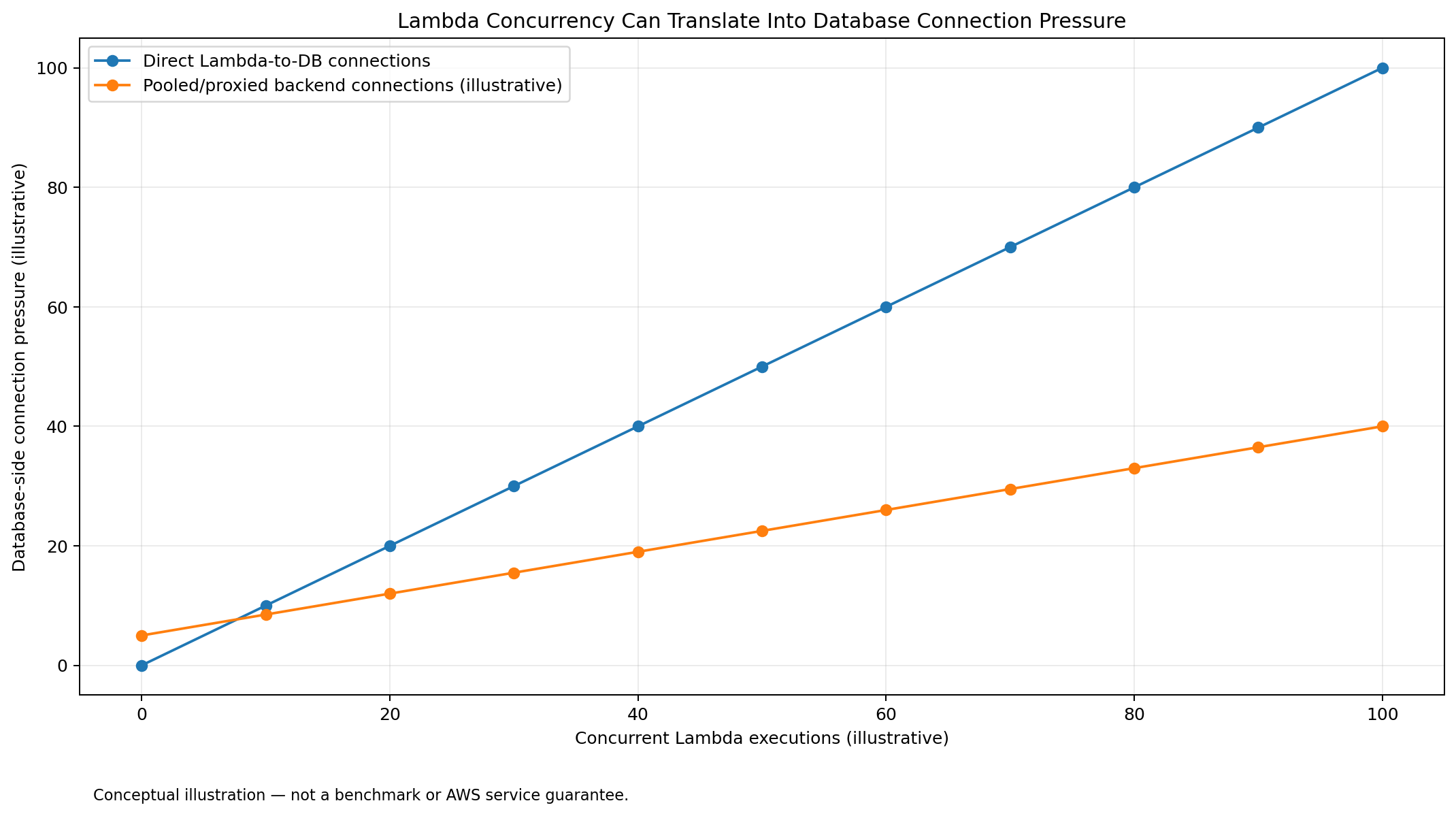
Compute scaling is working exactly as intended, but the database suddenly receives much more parallel work.
Design around downstream capacity
The solution is not to prevent Lambda from scaling. It is to make scaling respect the capacity envelope of the system.
1. Determine the database-safe concurrency level
Start with the database, not the Lambda quota.
Measure how many concurrent application operations the database can sustain while maintaining acceptable:
- query latency;
- CPU utilization;
- connections;
- transaction performance;
- error rates.
Do not confuse the database’s configured maximum connection count with a safe application concurrency target. A database operating near its absolute connection limit has little capacity left for administration, migrations, monitoring, or other workloads.
2. Reuse and pool connections
Opening a new database connection for every request creates additional work and connection churn.
For Lambda workloads using RDS, AWS recommends Amazon RDS Proxy for production scenarios where functions frequently create short-lived connections. RDS Proxy maintains a shared connection pool and can multiplex application connections onto fewer database connections.
The architecture becomes:
API Gateway
     |
   Lambda
     |
 RDS Proxy
     |
 Aurora / RDS
RDS Proxy helps manage connections, but it does not make expensive queries inexpensive or remove database capacity limits.
3. Put a ceiling on concurrency when necessary
Reserved concurrency can place an upper limit on simultaneous executions of a Lambda function. AWS specifically identifies protecting downstream resources such as database connections as a use case for this control.
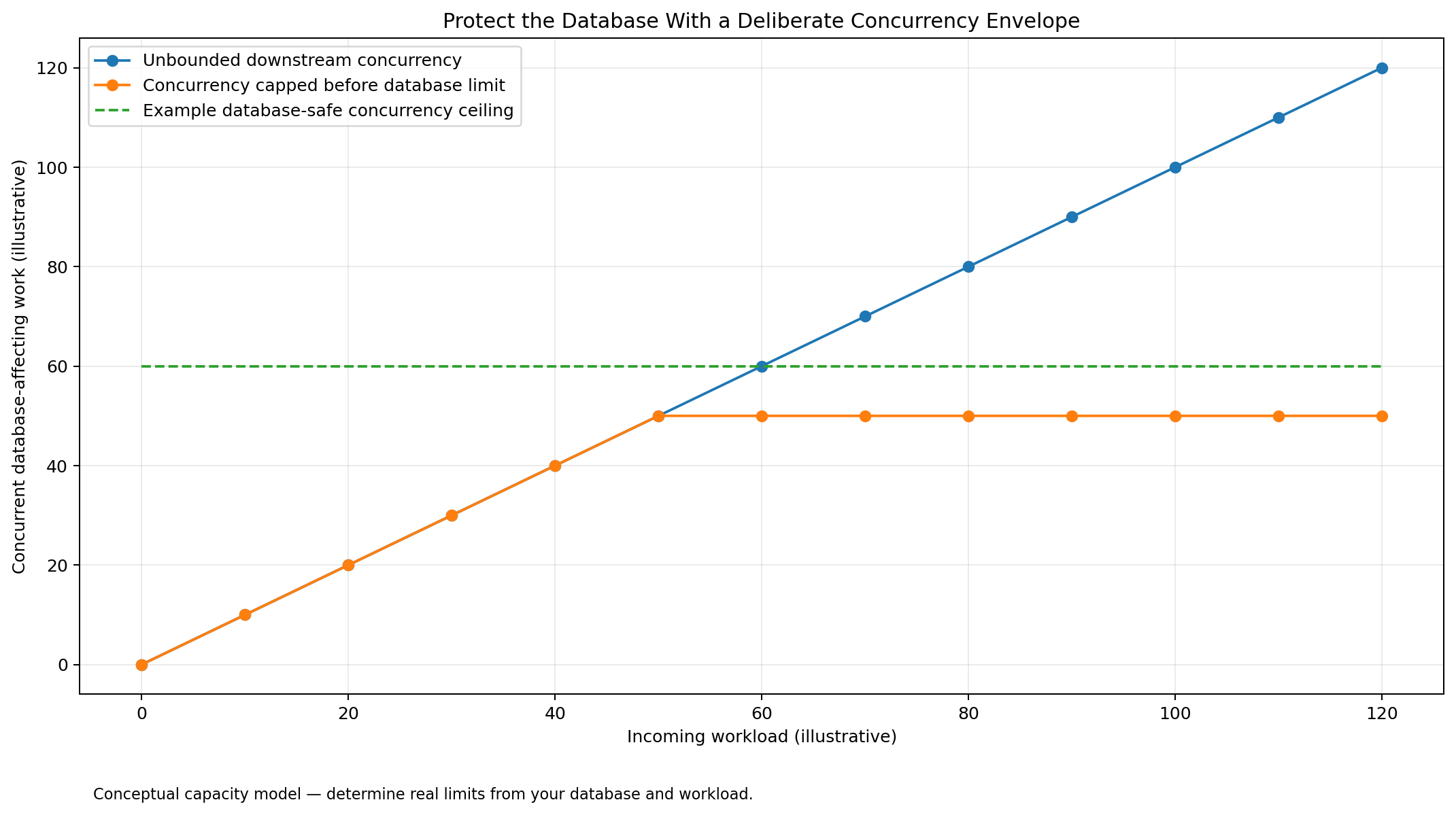
For example, if testing shows that a particular workload should never perform more than 80 concurrent database operations, allowing the corresponding function to expand indefinitely is probably the wrong design.
The trade-off is deliberate: excess requests may wait or be throttled instead of overwhelming the database.
That is often preferable to turning a temporary traffic spike into a database-wide outage.
4. Introduce a queue when work does not need an immediate response
For asynchronous workloads, SQS can provide backpressure:
Producer
   |
  SQS
   |
Lambda Workers
   |
RDS Proxy
   |
Database
Instead of allowing incoming traffic to dictate database concurrency directly, messages accumulate in the queue and consumers process them at a controlled rate.
This pattern is especially useful for imports, notifications, document processing, aggregation jobs, and other operations that do not require an immediate HTTP response.
Example: appointment import
Consider a SaaS application importing appointments from an external system.
Normally it processes a few records per second. A customer uploads a file containing 20,000 appointments, and the implementation invokes processing functions aggressively in parallel.
Each invocation:
- looks up the customer;
- checks for duplicate appointments;
- inserts the appointment;
- updates related data.
Lambda can increase concurrency quickly. The Aurora database now receives hundreds of simultaneous transactions instead of its normal workload.
The better design is:
Upload
  |
SQS
  |
Lambda
(max controlled concurrency)
  |
RDS Proxy
  |
Aurora
The import may take longer, but interactive users continue receiving predictable database performance.
Watch out for retry amplification
Database saturation can create slow queries and connection failures. Those failures may trigger retries from clients, SDKs, event sources, or application code.
Now an overloaded database receives additional requests caused by the overload itself.
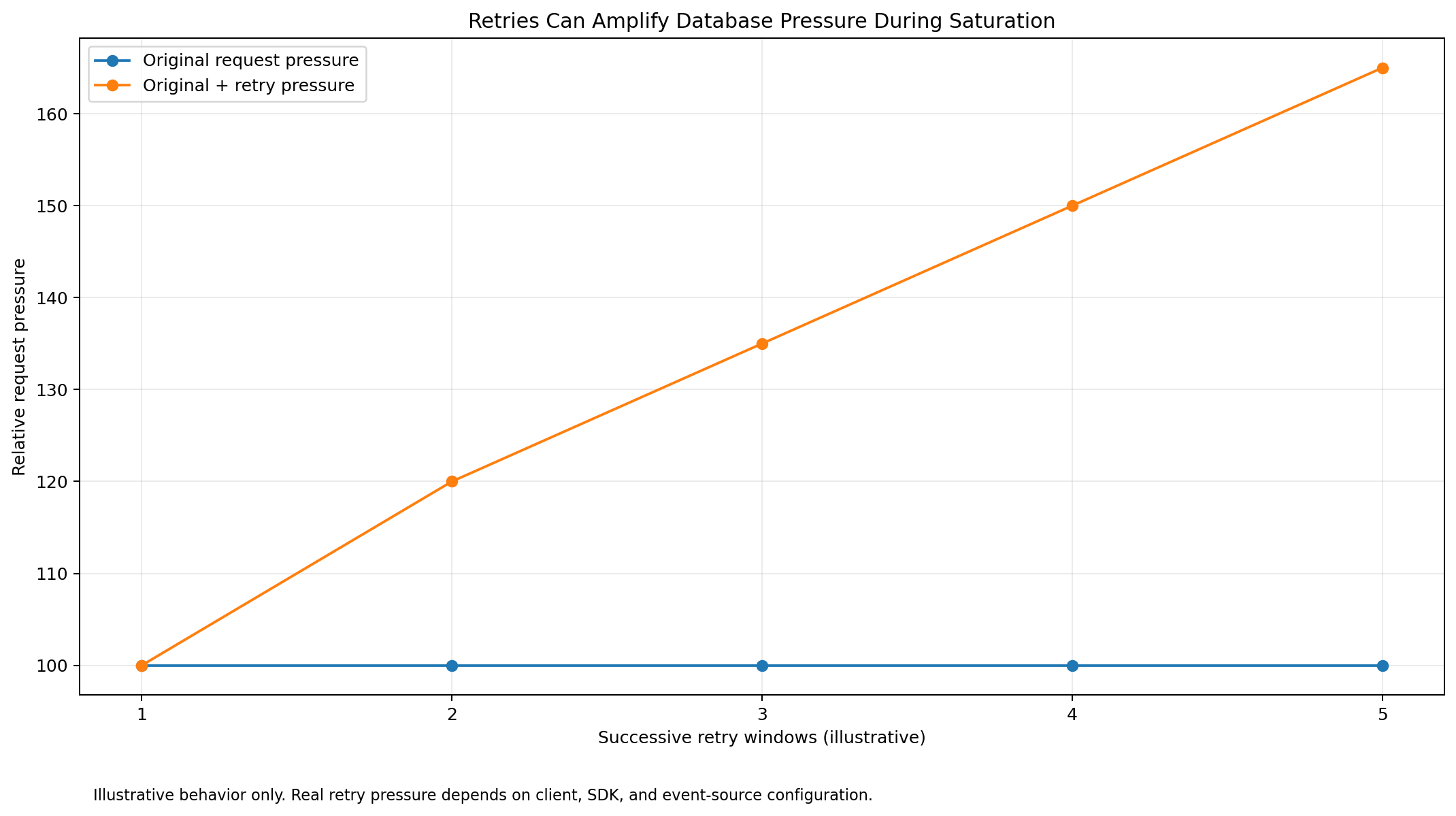
Retries should therefore use bounded attempts, exponential backoff, and jitter where appropriate. More importantly, retries should not substitute for controlling concurrency.
Common mistakes
One common mistake is assuming serverless means every component scales automatically. Serverless compute can still depend on resources with fixed or slower-changing capacity.
Another is adding RDS Proxy and considering the problem solved. Connection pooling helps connection management; it does not protect against inefficient SQL, locking, excessive transactions, or simply too much parallel database work.
Provisioned concurrency is also sometimes confused with a database-protection mechanism. Its primary purpose is keeping Lambda execution environments initialized to reduce startup latency. Reserved concurrency is the relevant control when you need an upper bound on a function’s concurrency.
Conclusion
A scalable Lambda function does not automatically create a scalable system. The architecture must respect the capacity of its slowest downstream dependency.
Measure the database’s safe operating range, use connection pooling where appropriate, cap concurrency when necessary, and introduce queues when work can be processed asynchronously. As a practical next step, compare the peak concurrency of every database-facing Lambda function with the database capacity it is allowed to consume.