
What an AWS Architecture Assessment Should Include
An AWS architecture assessment should do more than compare a system against a list of cloud best practices. It should explain how the system works, identify material risks, and give the team a realistic improvement plan.
A useful assessment connects technical findings to operational and business consequences: outages, security exposure, rising costs, slow delivery, or excessive dependence on individual developers.
Start With Scope and Business Context
Before reviewing AWS services, define what is being assessed.
A platform may contain dozens of accounts, applications, pipelines, and third-party integrations. Reviewing everything at the same depth usually creates noise rather than useful conclusions.
The assessment should identify:
- Critical workloads and user journeys
- Business and regulatory requirements
- Recovery expectations
- Known incidents or recurring problems
- Expected growth or architectural changes
- Constraints such as budget, deadlines, or legacy dependencies
For example, an appointment platform may consider booking creation, payment processing, and customer notifications critical. A failure in an internal reporting process may be inconvenient, while a failure that creates duplicate appointments directly affects customers.
This context determines which risks deserve attention first.
Document the Current Architecture
An assessment needs an accurate current-state view. Existing diagrams can help, but they should be validated against deployed infrastructure, configuration, and application behavior.
The architecture inventory should cover:
- AWS accounts, regions, and environments
- Networking and external entry points
- Compute services such as Lambda, ECS, or EC2
- Databases, queues, event buses, and storage
- Identity and access paths
- Deployment pipelines and infrastructure as code
- Monitoring, logging, backup, and recovery mechanisms
- External systems and data exchanges
Infrastructure as code, or IaC, means defining cloud resources through version-controlled files using tools such as AWS CloudFormation, AWS CDK, or Terraform. When IaC exists, it provides valuable evidence, but it may not reflect manual changes made directly in AWS.
The goal is not to produce a decorative diagram. The goal is to make service boundaries, dependencies, trust boundaries, and critical data flows understandable.
Review the Main Risk Domains
A practical assessment should evaluate several connected domains.
Security
Review authentication, authorization, encryption, secrets, public exposure, audit logging, and IAM policies.
IAM, or Identity and Access Management, controls which users and services can perform actions in AWS. Look for broad permissions, shared credentials, unused roles, missing multi-factor authentication, and workloads that can access more resources than required.
The assessment should also trace sensitive data from entry point to storage rather than reviewing individual services in isolation.
Reliability and Recovery
Identify single points of failure, retry behavior, timeout settings, backup coverage, and recovery procedures.
Confirm whether recovery objectives are defined. Recovery Time Objective describes how quickly a system should be restored. Recovery Point Objective describes how much data loss is acceptable.
A backup is not sufficient evidence of recoverability. The team should know whether restoration has been tested and who is responsible for executing it.
Performance and Scalability
Review service limits, concurrency, database access patterns, caching, asynchronous processing, and expected traffic changes.
The objective is not to maximize theoretical scale. It is to determine whether the architecture can handle realistic demand without unstable latency, throttling, or unnecessary complexity.
Operations and Delivery
Assess deployment safety, rollback options, environment consistency, monitoring, alert quality, incident response, and operational ownership.
Useful questions include:
- Can the team identify the cause of a failed request?
- Can a deployment be rolled back safely?
- Are alerts tied to customer impact?
- Is critical operational knowledge documented?
- Can another engineer operate the system during an absence?
Cost
Cost reviews should connect spending to architecture and usage.
Look for idle resources, oversized databases, excessive data transfer, inefficient logging, unsuitable storage tiers, and services whose pricing model does not match the workload.
The cheapest design is not automatically the best design. Reducing redundancy, observability, or backup retention may lower the AWS bill while increasing operational risk.
Use an Evidence-Based Workflow
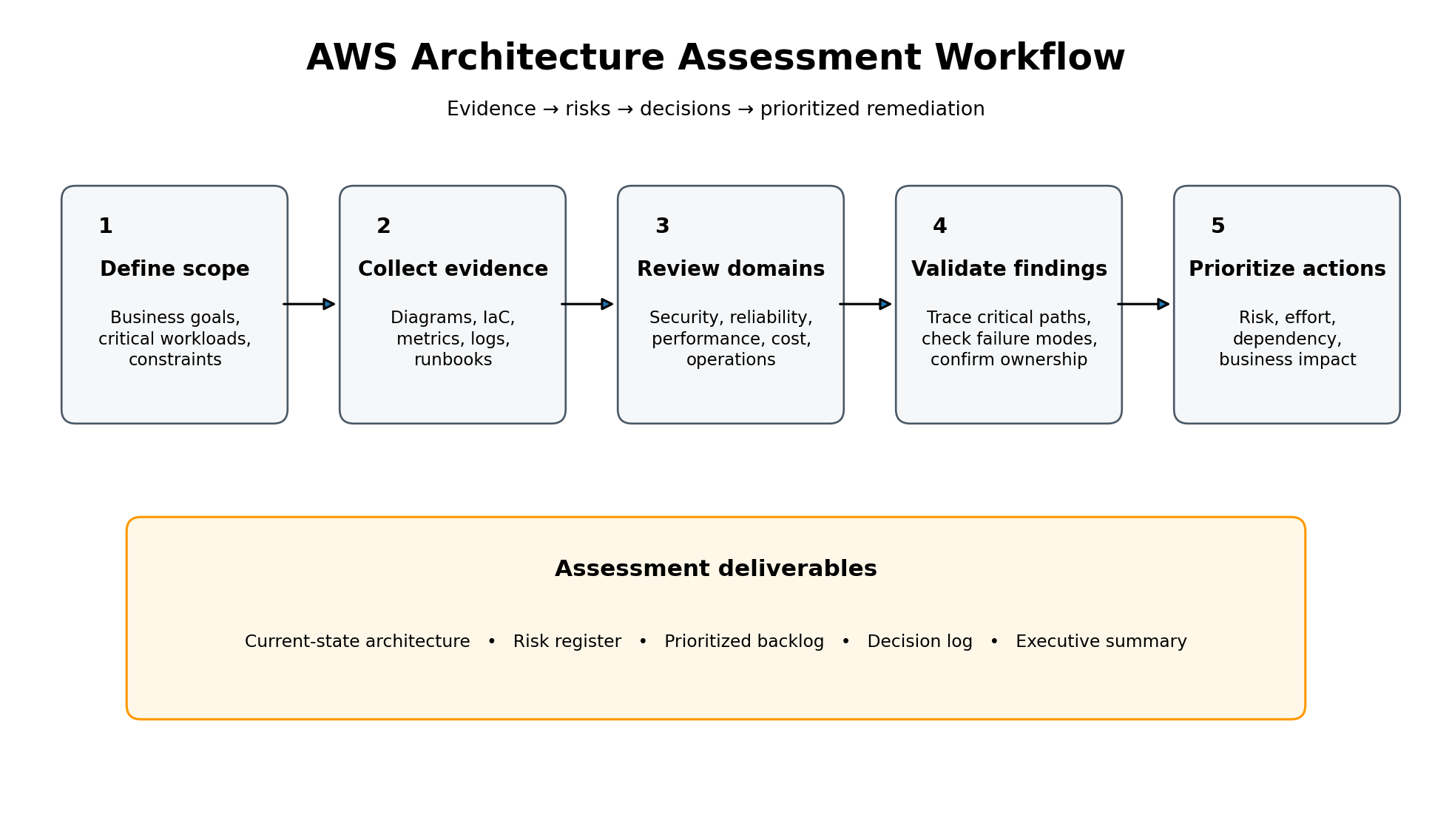
A repeatable assessment can follow five steps:
- Define scope. Identify critical workloads, business expectations, and constraints.
- Collect evidence. Review diagrams, repositories, IaC, AWS configuration, logs, metrics, incident records, and runbooks.
- Trace critical paths. Follow important requests through APIs, services, databases, queues, and external providers.
- Record and validate risks. Confirm each finding with evidence and discuss disputed assumptions with the responsible team.
- Prioritize remediation. Rank actions by impact, likelihood, effort, dependencies, and urgency.
The final deliverables should normally include a current-state architecture, risk register, prioritized remediation backlog, executive summary, and relevant architecture decisions.
Example: Serverless Order Processing
Consider an order API using Amazon API Gateway, Lambda, DynamoDB, EventBridge, and a third-party payment provider.
The assessment finds that Lambda writes the order before calling the payment provider. If the payment request times out, the client retries and creates a second order because no idempotency key is used.
The issue is not simply “add retries.” Uncontrolled retries can make duplication worse.
A practical recommendation would introduce an idempotency key, store payment state explicitly, and move payment processing behind a durable queue or event workflow. The backlog should also include duplicate-payment alarms, reconciliation procedures, and tests for timeout scenarios.
This finding connects an implementation detail to a concrete business risk: duplicate orders and payment disputes.
Trade-Offs and Common Mistakes
A common mistake is treating AWS Well-Architected questions as the complete assessment. The framework is useful, but a questionnaire cannot replace tracing application behavior, reviewing code, and validating operational procedures.
Another mistake is producing a long list of findings without prioritization. Twenty minor configuration improvements can distract from one untested recovery process or publicly exposed data store.
Assessments also have limits. A short review can identify visible risks but may not prove application correctness, security compliance, or disaster-recovery readiness. Those conclusions may require penetration testing, load testing, restore exercises, or deeper code analysis.
Conclusion
An AWS architecture assessment should explain the current system, show where material risks exist, and convert those risks into an actionable backlog. The strongest assessments combine cloud configuration, application behavior, operational evidence, and business context.
Start by selecting one critical workflow and tracing it from the external request to its final data and operational effects. That exercise usually reveals more than beginning with a generic service checklist.