
Architecture Documentation for Serverless Systems: Make Execution Paths Visible
Serverless systems remove much of the infrastructure management, but they do not remove architectural complexity. Business behavior may be distributed across functions, event buses, queues, managed databases, permissions, deployment configuration, and retry policies.
Useful documentation should help an engineer answer three questions quickly: what happens, where it happens, and what happens when it fails.
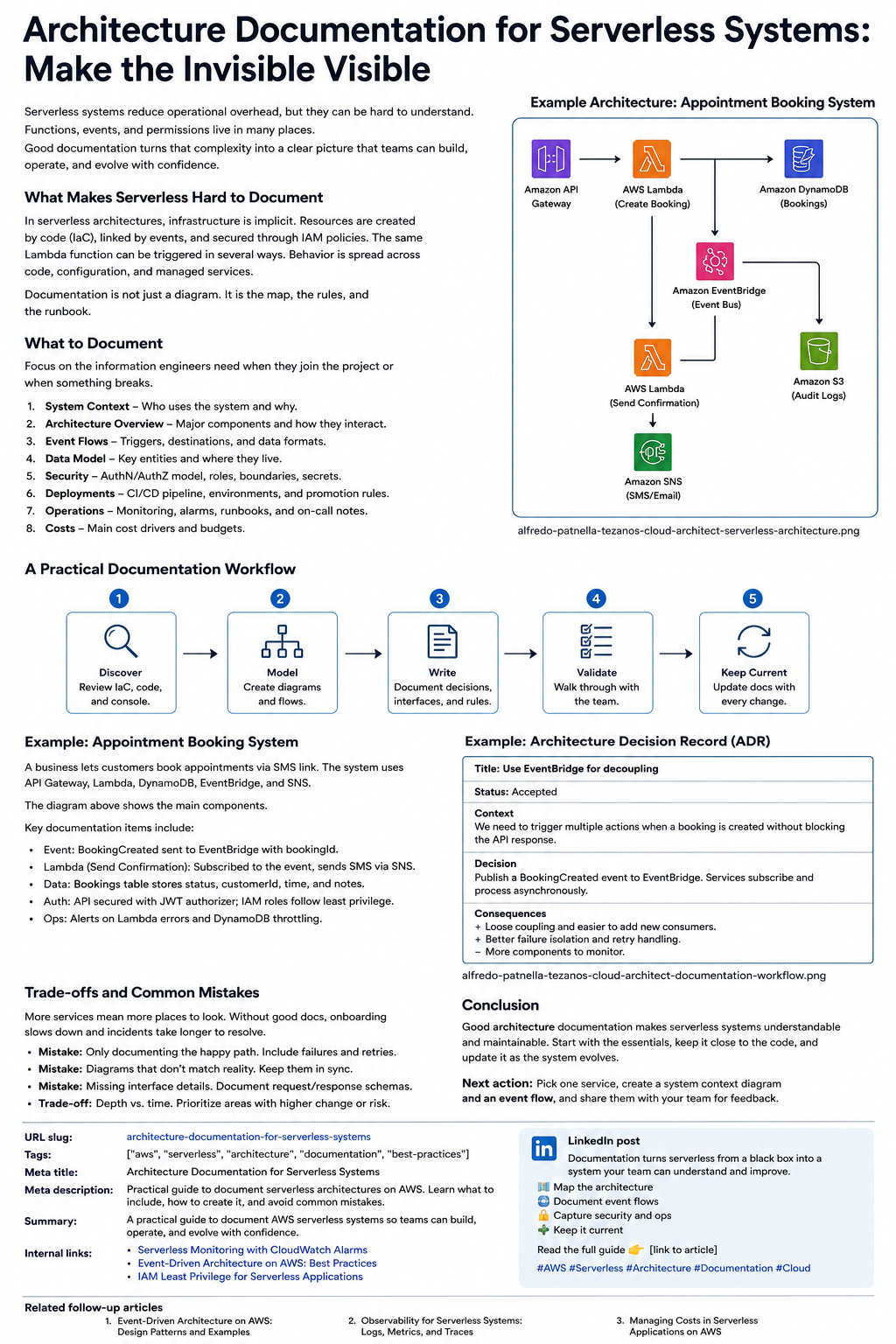
What serverless documentation must explain
A traditional application may have a small number of long-running services with relatively visible request paths. In a serverless system, one action can trigger several asynchronous operations across independently deployed components.
For example, an API Gateway request may invoke a Lambda function, write to DynamoDB, publish an EventBridge event, trigger another function, send a notification through SNS, and place a failed event in a dead-letter queue.
A service inventory alone does not explain this behavior. Documentation must capture the relationships between services.
At minimum, document four layers:
- System context: Users, external systems, entry points, and major trust boundaries.
- Component architecture: Functions, APIs, databases, queues, event buses, storage, and third-party integrations.
- Runtime behavior: Request flows, events, retries, failure paths, and asynchronous processing.
- Operations: Deployment, monitoring, alarms, recovery procedures, quotas, and ownership.
These layers serve different purposes. A context diagram helps a new team member understand the system. An event-flow document helps a developer modify it safely. A runbook helps the on-call engineer recover it.
A practical documentation workflow
1. Reconstruct the deployed system
Start with what is actually deployed, not what an old design document says should exist.
Review:
- Infrastructure-as-code templates
- Lambda configuration and triggers
- API Gateway routes
- EventBridge rules
- SNS topics and SQS queues
- DynamoDB tables and indexes
- IAM roles and resource policies
- CloudWatch alarms and dashboards
Infrastructure as code, or IaC, is code that defines cloud resources. AWS CDK, CloudFormation, Terraform, and AWS SAM are common examples.
The deployed environment remains the best reference when code and documentation disagree.
2. Draw the system context
Create a small diagram showing:
- Primary users
- External systems
- Public and private entry points
- Authentication boundaries
- Data leaving the system
Do not place every Lambda function in this diagram. Its purpose is orientation, not implementation detail.
3. Map the critical execution paths
Select the workflows that matter most to the business or create the most operational risk.
For each workflow, document:
- Trigger
- Components involved
- Data written or published
- Synchronous and asynchronous steps
- Retry behavior
- Timeout behavior
- Duplicate-processing protection
- Final success condition
- Failure destination
Duplicate-processing protection is commonly called idempotency. An idempotent handler can process the same request or event more than once without producing an incorrect second result.
4. Document contracts, not only components
Event-driven systems depend on contracts between producers and consumers.
For an event, record:
eventName: BookingCreated
producer: CreateBookingFunction
destination: booking-events
requiredFields:
  - bookingId
  - customerId
  - tenantId
  - occurredAt
failureDestination: booking-events-dlq
The document should identify the source of truth for the full schema. Avoid maintaining several manually copied versions of the same contract.
For APIs, document authentication, request shape, response shape, error codes, and ownership.
5. Record important decisions
Use short Architecture Decision Records, or ADRs, for decisions that are not obvious from the code.
A useful ADR contains:
- Context
- Decision
- Alternatives considered
- Consequences
- Status
For example, an ADR may explain why EventBridge was selected instead of invoking several Lambda functions directly. The important value is not the service choice itself, but the reasoning and accepted consequences.
6. Add operational documentation
A diagram does not tell an engineer how to respond to a failed deployment or a growing queue.
Document:
- Relevant CloudWatch dashboards
- Alarm thresholds and ownership
- Dead-letter queue recovery
- Replay procedures
- Concurrency limits
- Service quotas
- Deployment and rollback process
- Environment-specific differences
- Data retention and deletion rules
Keep runbooks short enough to use during an incident.
Example: appointment booking workflow
Consider a serverless appointment platform.
A customer submits a booking through API Gateway. A Lambda function validates the request, stores the appointment in DynamoDB, and publishes a BookingCreated event to EventBridge.
A notification function consumes the event and sends a confirmation through SNS. Another consumer writes an audit record to S3.
The workflow documentation should answer practical questions:
- Is the booking complete after the DynamoDB write or after notification delivery?
- What happens when EventBridge cannot invoke a consumer?
- Can the notification function receive the same event twice?
- Where can an operator find failed events?
- Which team owns replaying them?
- Does a notification failure affect the confirmed booking?
Without these answers, a diagram shows connectivity but not system behavior.
Trade-offs and common mistakes
Too much detail becomes difficult to maintain
A diagram containing every IAM action, environment variable, and generated resource will become outdated quickly. Keep diagrams at the level needed for decision-making and troubleshooting. Link to code or generated references for lower-level detail.
The happy path is not enough
Teams often document successful execution and omit retries, throttling, partial failures, and dead-letter queues. In serverless systems, these paths are part of the architecture, not exceptional implementation details.
Managed does not mean simple
AWS manages the underlying infrastructure, but the application still owns permissions, event contracts, concurrency, ordering assumptions, and failure recovery.
Documentation can drift from reality
Architecture documents should be reviewed with meaningful infrastructure or workflow changes. Treat documentation updates as part of the change, rather than a separate cleanup activity.
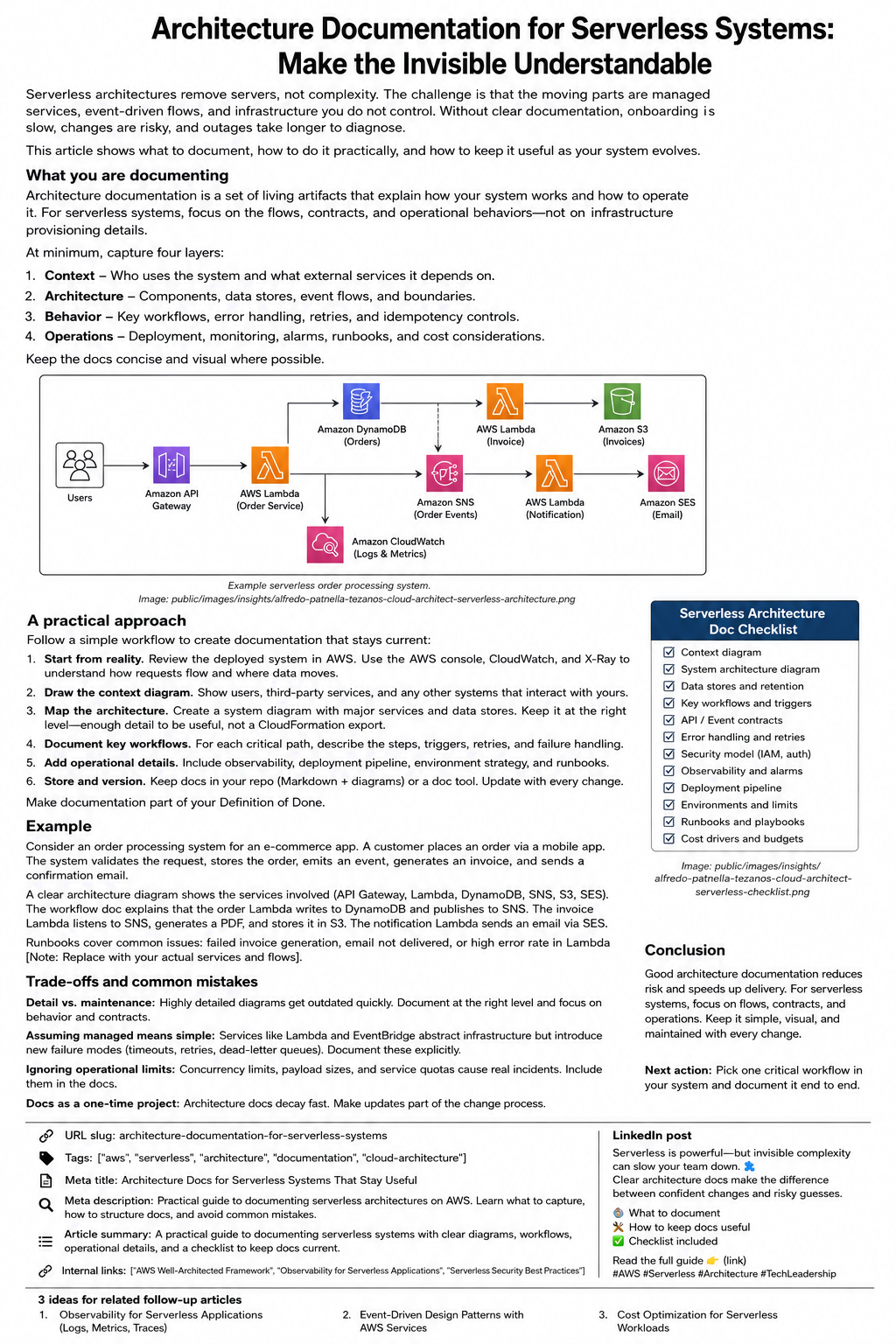
Conclusion
Good serverless documentation connects architecture diagrams with execution flows, contracts, decisions, and operational procedures. It should help an engineer understand a critical workflow without reconstructing the entire system from AWS configuration.
Start with one business-critical path. Document its trigger, services, data movement, failure behavior, and operational recovery from beginning to end.