
When to Use SQS vs SNS vs EventBridge
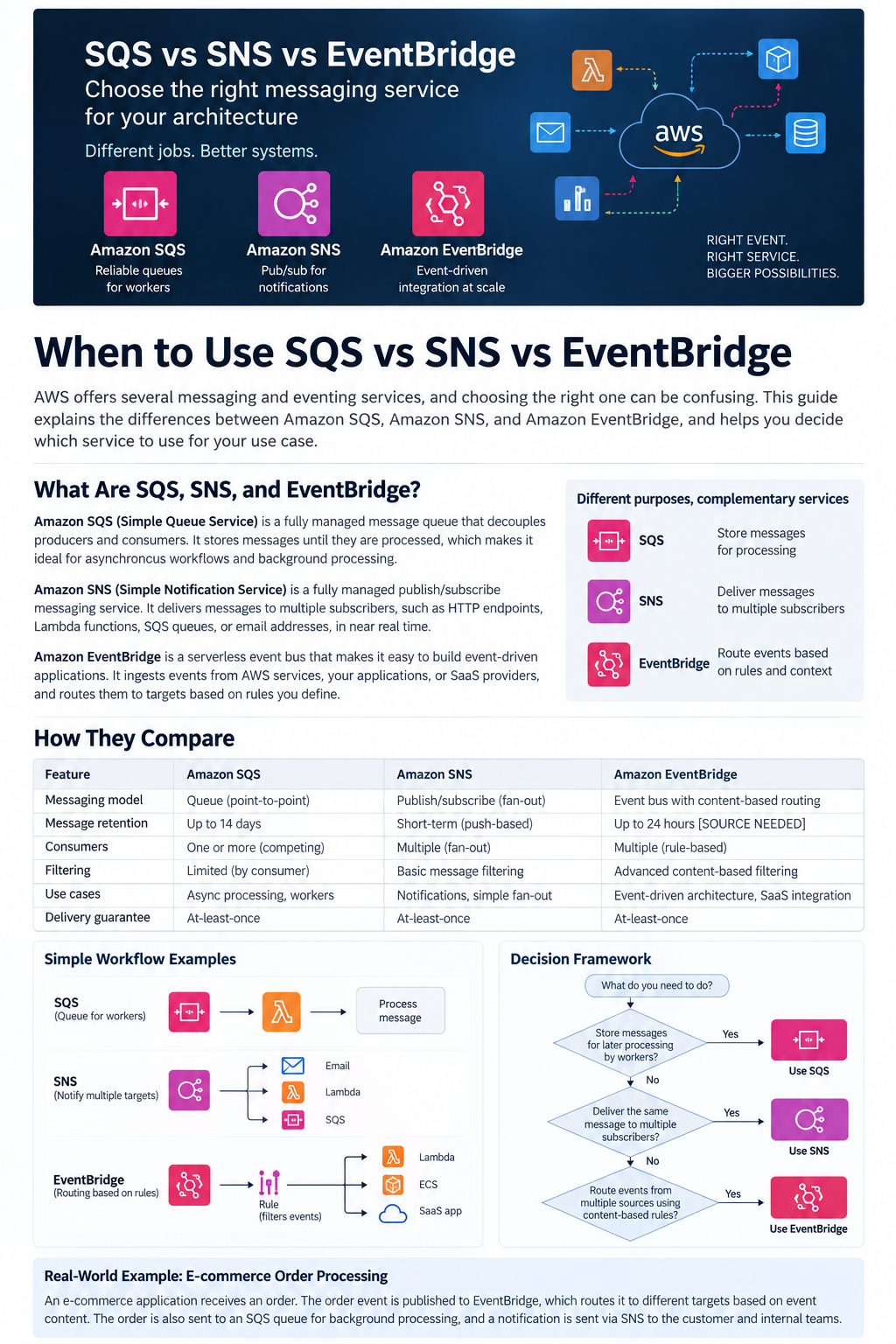
AWS gives you several ways to move messages between components, but SQS, SNS, and EventBridge solve different problems. Choosing the wrong one can introduce unnecessary complexity or leave you without the buffering, routing, or delivery behavior your workload actually needs.
The simplest way to decide is to start with one question: what should happen to the message after it is published?
What SQS, SNS, and EventBridge Actually Do
Amazon SQS: queue work for processing
Amazon Simple Queue Service (SQS) is a message queue. A producer puts a message into the queue, and a consumer retrieves and processes it.
The important part is that the message waits in the queue until a consumer can handle it. That makes SQS useful when producers and consumers operate at different speeds.
A typical pattern is:
API → SQS → Lambda workerIf 5,000 requests suddenly arrive, the API can enqueue work rather than requiring your workers or database to absorb all 5,000 operations immediately.
Standard SQS queues provide at-least-once delivery, so consumers should be idempotent: processing the same message more than once should not produce incorrect results. FIFO queues add ordering and deduplication capabilities when those requirements matter.
Use SQS when you need buffering, asynchronous processing, retries, or workload smoothing.
Amazon SNS: send one message to many subscribers
Amazon Simple Notification Service (SNS) uses a publish/subscribe model.
A producer publishes once:
Application → SNS
                ├── Lambda
                ├── SQS
                └── HTTP endpoint
Each subscriber receives its own copy of the message.
That makes SNS useful for straightforward fan-out. For example, an InvoiceGenerated notification might need to trigger an email process, an analytics pipeline, and a downstream accounting integration.
SNS subscriptions can also use filter policies so that subscribers receive only messages matching selected attributes or message-body values.
SNS is still primarily a delivery mechanism rather than a durable work queue. When a subscriber must reliably process work later, a common pattern is SNS → SQS, giving each consumer its own queue.
Use SNS when the main requirement is broadcasting a message to multiple known subscribers.
Amazon EventBridge: route events according to rules
Amazon EventBridge is an event router.
Instead of thinking primarily in terms of sending a message to a destination, think in terms of publishing something that happened:
{
  "source": "orders",
  "detail-type": "OrderCreated",
  "detail": {
    "orderId": "1234",
    "region": "CA"
  }
}
EventBridge evaluates the event against rules and forwards matching events to appropriate targets.
A rule could say:
OrderCreated + region=CA → Canadian fulfillment service
OrderCreated + total>5000 → fraud review workflow
OrderCancelled → inventory service
EventBridge can receive events from custom applications, AWS services, and supported SaaS sources, then route matching events to AWS services and other destinations.
Use EventBridge when routing decisions depend on the event itself or when many independent producers and consumers need loose coupling.
A Practical Decision Framework
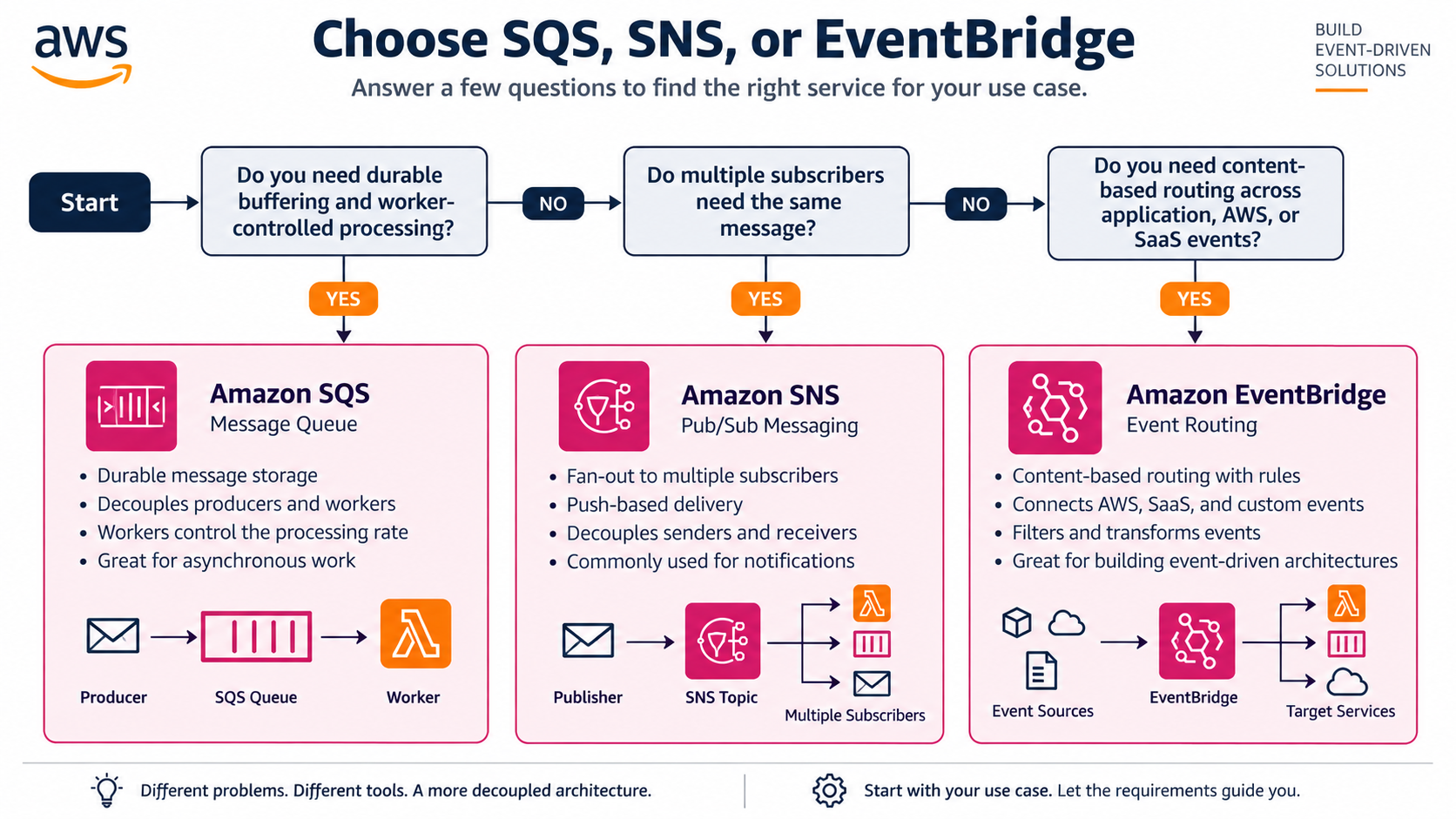
Start with these questions:
-
Does work need to wait safely until a consumer can process it? Use SQS.
-
Should the same message immediately go to multiple subscribers? Use SNS.
-
Should events be routed differently depending on their contents, source, or type? Use EventBridge.
-
Do individual subscribers also need buffering and independent retry behavior? Combine services, for example:
SNS → SQS → Workeror:
EventBridge → SQS → WorkerThese services are complementary. You do not need to force an architecture into using only one.
Example: Processing an E-Commerce Order
Consider an application that publishes an OrderCreated event.
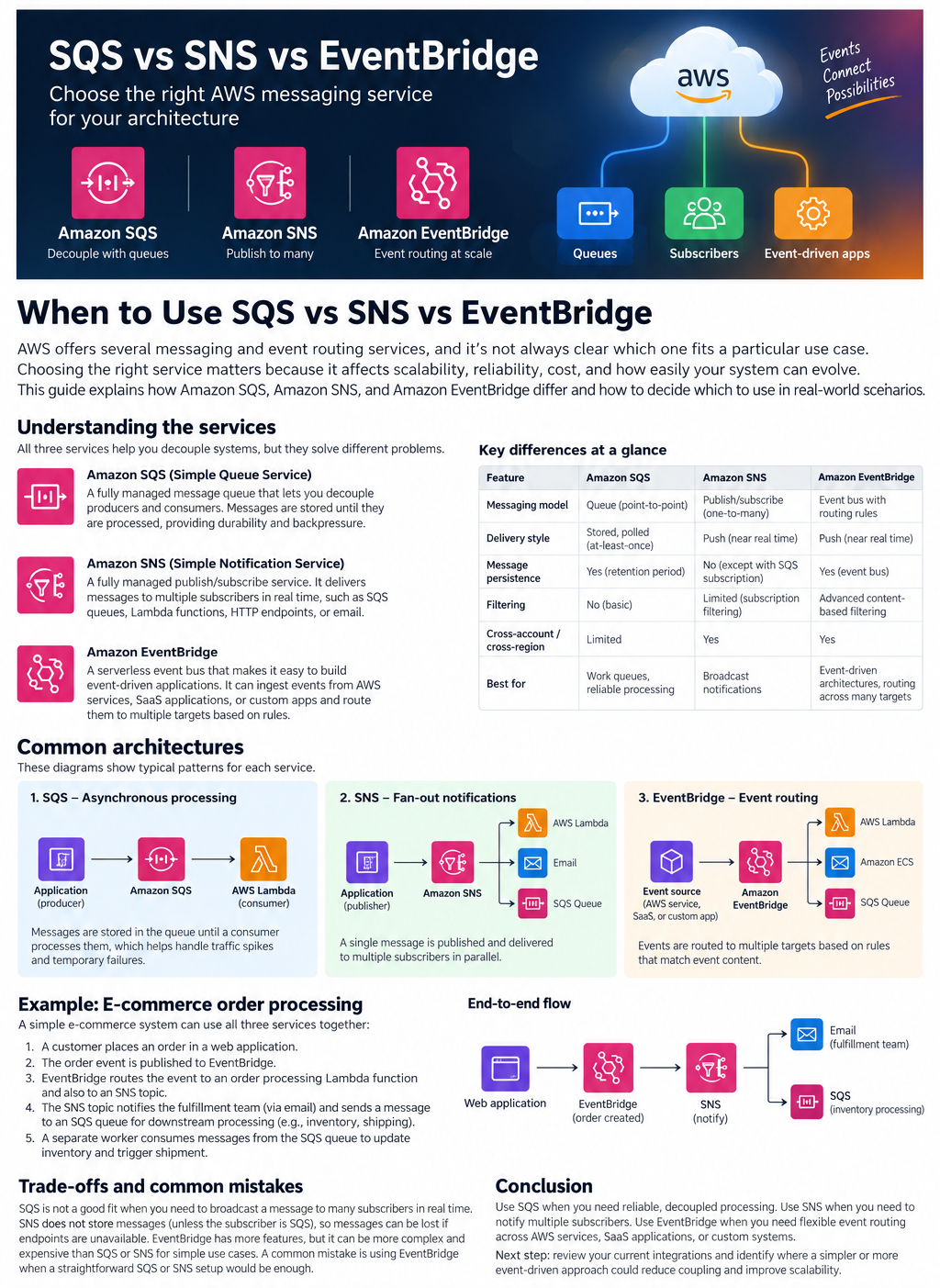
EventBridge can act as the central router:
Order Service
     ↓
EventBridge
     ├── OrderCreated → SQS → Fulfillment Worker
     ├── OrderCreated → Analytics Lambda
     └── HighValueOrder → Fraud Review
SQS protects the fulfillment system from traffic spikes because orders can accumulate until workers have capacity.
If several systems need the exact same notification without complex routing, SNS could instead fan that message out to separate SQS queues.
The architecture becomes easier to reason about when each service has one clear responsibility.
Trade-Offs and Common Mistakes
A common mistake is using EventBridge simply because the system is described as “event-driven.” EventBridge adds powerful routing capabilities, but a single producer feeding a single worker may only need SQS.
Another mistake is using SNS alone for critical asynchronous processing. If a downstream consumer must be able to process messages independently after an outage, placing an SQS queue behind the SNS subscription usually provides a stronger processing boundary.
Also avoid assuming that message delivery means exactly-once business processing. Standard SQS can deliver messages more than once, and distributed systems can retry operations at several layers. Consumers that update payments, inventory, or other state should therefore be designed for idempotency.
Choose Based on the Job
The practical distinction is simple: SQS buffers work, SNS broadcasts messages, and EventBridge routes events.
Start with the simplest service that satisfies the requirement. Add combinations such as SNS → SQS or EventBridge → SQS only when fan-out, routing, buffering, or independent failure handling requires them.