
Step Functions vs Lambda Orchestration: Where State Belongs
A Lambda function that calls three other services can feel perfectly reasonable. The trouble starts when that function also owns retries, branching, waiting, partial failures, and the question: what already succeeded?
The useful distinction is not “code versus no code.” It is deciding where workflow state and recovery logic should live.
What Lambda orchestration really means
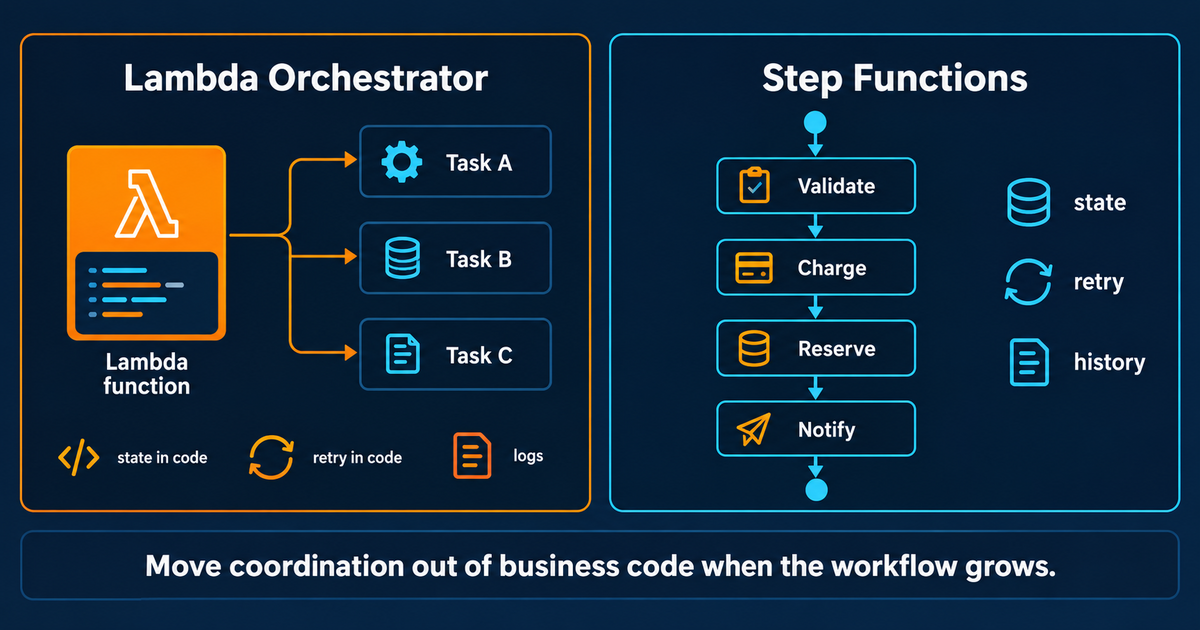
In a plain Lambda orchestrator, application code coordinates the workflow. It may validate input, invoke another Lambda, write to DynamoDB, call a payment API, and publish a message. For a short flow with few failure paths, this keeps the architecture compact.
But coordination is now mixed with business logic. The function needs to know which operations completed, which can be retried safely, and what to do after a partial failure. Logs may tell you what happened, but reconstructing the workflow can require correlating several entries and external side effects.
AWS Step Functions makes that coordination explicit. A state machine describes tasks, choices, parallel work, waits, retries, and failure paths. It can also call many AWS services directly, so a Lambda function is not required for every step. Standard Workflows persist state between transitions and provide execution history, while Express Workflows target shorter, high-volume executions with different delivery semantics.
A practical decision framework
Start with the failure model rather than the number of boxes in the diagram.
-
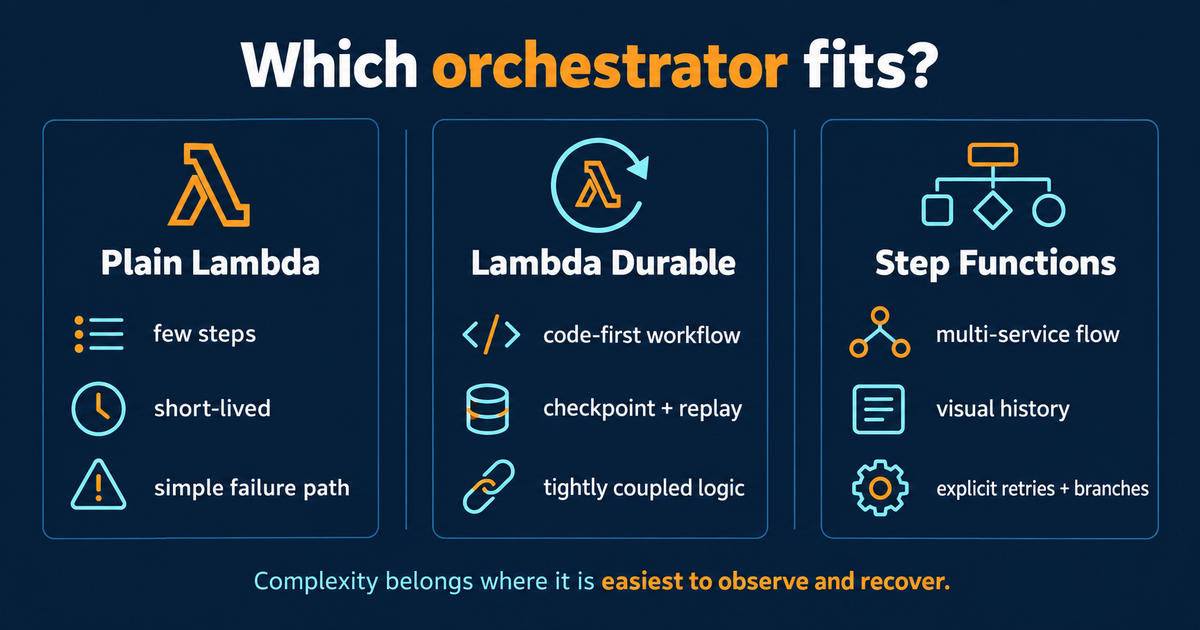
Use a plain Lambda orchestrator for small, bounded coordination. If the work finishes quickly, has few steps, and can fail as one unit, keeping it in code may be the simpler choice. A normal Lambda invocation has a maximum runtime of 15 minutes.
-
Move to Step Functions when state becomes a first-class concern. If steps need different retry policies, the workflow waits for another system, branches substantially, runs tasks in parallel, or operators need to see exactly where an execution failed, explicit orchestration earns its place.
-
Prefer service integrations where they remove glue code. Step Functions can invoke Lambda, send SQS messages, publish to SNS, work with DynamoDB, start jobs, and integrate with many other AWS APIs. A state that only wraps an SDK call may not need its own Lambda.
-
Design every retried side effect for idempotency. A retry must not accidentally charge a card twice, create duplicate records, or send an action twice. Orchestration improves recovery; it does not remove the need to understand duplicate execution.
There is also a newer middle option: Lambda Durable Functions. They provide checkpoint/replay, retries, and durable waits while keeping the workflow in regular application code. They are worth considering when orchestration is tightly coupled to Lambda business logic and a code-first model is preferable. Step Functions remains the clearer fit when the workflow spans services and benefits from an explicit state-machine view.
Example: processing an order
Consider an order flow:
Validate order → Authorize payment → Reserve inventory → Send confirmation
In a single Lambda, the happy path is easy. Now assume payment succeeds but inventory reservation times out. Retrying the whole function can authorize payment again unless the application tracks progress and makes the payment operation idempotent. Avoiding the retry may leave the order half-complete.
With Step Functions, each operation can be a separate state. Inventory reservation can have its own retry policy. A failure can transition to a compensation step, such as voiding the payment authorization. The execution history gives an operator a workflow-level view instead of requiring the orchestrator to build its own durable progress model.
This does not make distributed transactions atomic. Compensation can fail too, so it still needs retries, idempotency, alarms, and a path for manual intervention.
Trade-offs and common mistakes
Step Functions adds a state-machine definition, IAM permissions, execution semantics, quotas, and its own pricing model. For three synchronous calls with straightforward error handling, that may be more machinery than the problem needs.
The opposite mistake is keeping orchestration in Lambda because “it is only code.” A function that accumulates custom retry loops, sleep/poll cycles, branching flags, and progress records is already implementing a workflow engine—just one the team must operate itself.
Also choose the Step Functions workflow type deliberately. Standard Workflows can run for up to one year and support callback and job-run integration patterns. Express Workflows run for up to five minutes and use different execution guarantees. Those semantics should match the side effects in the workflow, not simply expected traffic volume.
The practical takeaway
Keep ordinary Lambda orchestration when coordination is genuinely small. When recovery, waiting, branching, or operational visibility becomes part of the problem, make workflow state explicit with Step Functions—or evaluate Lambda Durable Functions when a code-first durable workflow better fits the application.
A useful next step is to inspect one production orchestrator and count how much of its code exists only to coordinate, retry, wait, or recover. If that code dominates the business operation, the orchestration boundary is probably in the wrong place.
Architecture decisions like this are easier when you can see the environment they operate in. ArchNube.com helps teams build a current picture of supported AWS resources and identify explainable architectural findings using a narrow, read-only, customer-controlled IAM role and a deterministic rule engine—without write access or black-box AI judgment.